
The Kirkland City Directory Shelf by Year
Kirkland's historical shelf is spread among nonprofit scans, state collections, archives, and library services. The Kirkland Heritage Society provides the easiest local entry point, while State Library and State Archives inventories establish broader runs. A year in a catalog is a lead, not proof that every Kirkland name or address survives.
| Collection | Years represented | Where held | Access route |
|---|---|---|---|
| Polk King County directories | 1872, 1876, 1878-79, 1882, 1884-1905, 1908-19, 1921-24, 1926-28, 1953-85, 1987, 1991 | Washington State Library; selected KHS and Archives holdings | Catalog check, appointment, or digitized scan |
| Kirkland city and telephone books | 1888; 1910-11; 1914; 1928-31; 1931-39; 1944-50 | Kirkland Heritage Society | Free online scans and resource links |
| Bellevue runs containing Kirkland | 1959, 1962-80, 1982-85 | Washington State Library | Limited Thursday appointment by email |
| State Archives Polk runs | 1914-15, 1919-20, 1922, 1925, 1931, 1938-40, 1948-83 | Puget Sound Regional Branch | Weekday research by appointment |
| Kirkland address list | 1930 | Kirkland Heritage Society PDF | Online scan; verify its editorial scope |
The lists overlap, yet they are not interchangeable. Researchers should confirm the repository, volume title, locality heading, year, page, and image. No authoritative final publication year for a Kirkland city directory was established, so a catalog gap should not be presented as the end of printing.
Access also differs by keeper. KHS offers several scans directly, the State Library requires a current appointment route, and archival material may need advance consultation. Asking for one named volume and year is more effective than requesting every local directory at once.
Two Early Kirkland City Directories Up Close
The digitized 1888 Polk King County directory is a compact 13-page scan with names, trades, address numbers, and community abbreviations. Its key is essential because a short locality code can change how an entry is understood. The source includes residents such as a postmaster, miner, and a widow, showing that roles and status notes sit beside names rather than forming a uniform household census.
The 1910-11 Kirkland directory is richer. Its introduction reports a census population and a separate directory estimate, sketches ferry and stage access, and names local services and civic officers. Entries show spouses in parentheses, abbreviated roles, firms, and widow notation. They capture a town linked by lake travel, retail, mills, and telephone service, but they still omit some people and may describe a business tie rather than a home.
Neither scan succeeded as a local screenshot capture, so the authoritative PDFs remain the proper way to inspect the pages themselves.
How to Read a Kirkland City Directory Entry
A directory line compresses several facts into a few words. In the 1910-11 scan, “Andrews Chas L (Nancy), pres-gen mngr Lake Wash Tel Co” separates the listed name, spouse, role, and firm. “Cleaves Mamie D L (wid Arthur)” uses a widow note, while “h Seattle” warns that the person appears in Kirkland context even though the home notation points elsewhere.
| Listed name | Surname and abbreviated given names or initials; spelling can change between editions. |
|---|---|
| Parentheses | Often a spouse's given name in this run, not a second standalone listing. |
| Role or firm | An occupation, employer, business, civic post, or association printed for that year. |
| Address or locality | A street number, community code, or home notation that must be checked against the key. |
| Status notation | Abbreviations such as “wid” that need the volume's own definition and dated context. |
- Criss-cross directory
- A later directory section arranged by street or telephone number instead of surname.
- Householder index
- An address-order or head-of-household aid; it is not a count of every occupant.
- Abbreviation key
- The volume's guide to shortened names, places, roles, and status terms. Read it before interpreting an entry.
Kirkland Phone Books and the 1930 Address Scan
KHS links early phone-book runs for 1914, 1928-31, 1931-39, and 1944-50. A phone book can connect a named subscriber or business with an exchange and publication year. It may omit an unlisted number, print one household contact, or lag a recent move. Those limits make it supporting evidence, not a complete Kirkland city directory.
The Society's 1930 address PDF is only three pages. Treat it as an address-focused source and read the scan for editorial scope before drawing conclusions. A line proves that the source printed that entry, not that everyone at the place was named or that the same street label survives now.
Note: Record the publication year and page because a telephone or address listing can become misleading when detached from its date.
Library and Archives Access for Kirkland City Directories
The Kirkland Library is a sound local orientation point, though its public page does not give a shelf-level inventory of Kirkland directories or identify a separate local-history room. The branch opened in 1995 after local library service that began with the Women's Club library in 1925, followed by city and KCLS changes. Ask staff to check the catalog and database access instead of assuming a volume is on an open shelf.
The Washington State Library closed to general public access in July 2025 and now offers limited Thursday appointments by email. The Puget Sound Regional Branch in Bellevue provides weekday research by appointment and holds Polk runs plus property, census, probate, marriage, and voter collections. Seattle Public Library's genealogy service offers help in person, by phone, or virtually, with some databases or materials limited to library use.
The live KCLS branch page shows the first of those access routes:
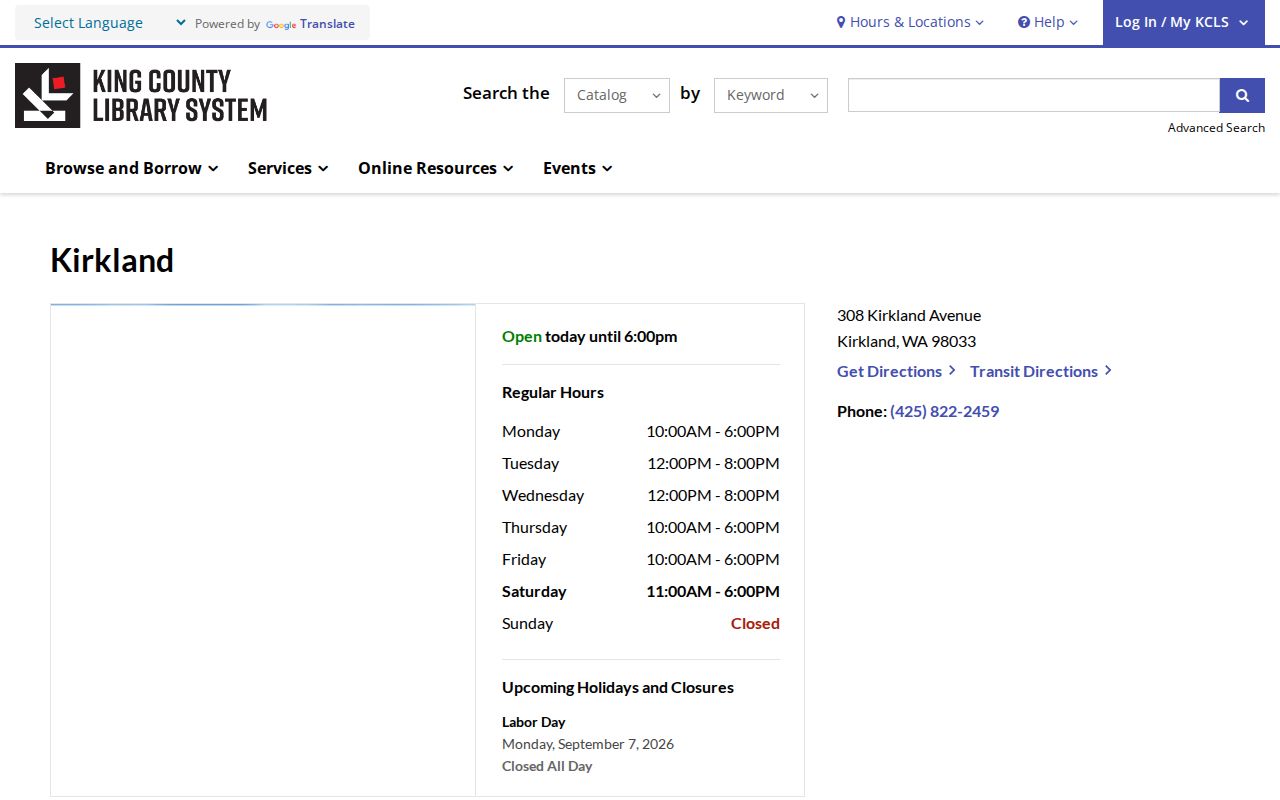
This capture supports a branch inquiry, not a claim that every historic directory is held onsite.
Before traveling, send staff the surname, approximate years, likely Kirkland or former-community label, and the kind of fact sought. That short brief lets a librarian distinguish a catalog search, database search, microfilm question, or referral to Bellevue, Seattle, or county archives.
Kirkland Heritage Links Beyond the Directory Shelf
The Kirkland Heritage Society local-resources page connects researchers with the City, Eastside institutions, county archives, and Washington archival services. It is especially useful when a city directory gives an occupation, firm, ferry reference, or civic office that needs newspaper or local-history context.
The resource network appears in this successful capture:
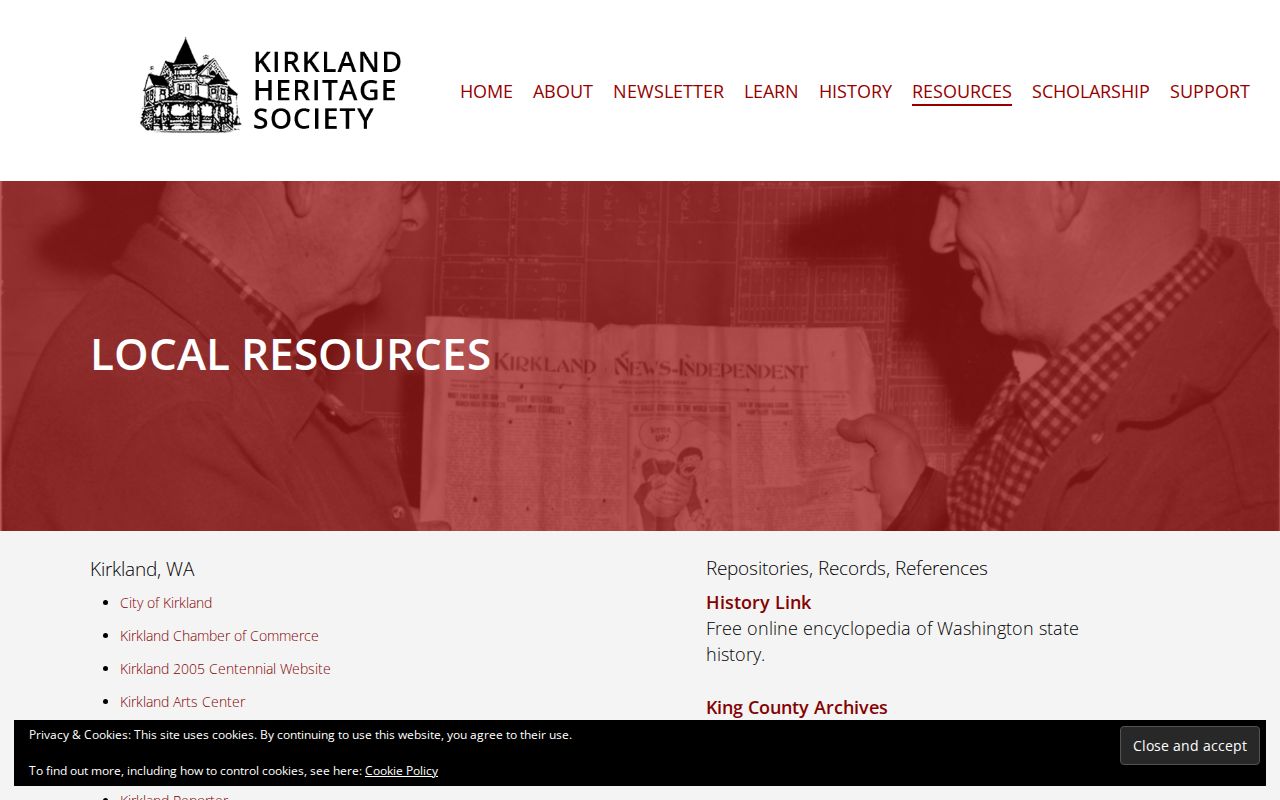
The linked institutions help test a lead across catalogs and primary records rather than turning one directory line into a full biography.
Maps and Land Records Beside a Kirkland City Directory
A directory address gains meaning when paired with a dated map or parcel record. The Library of Congress has a verified February 1892 Kirkland Sanborn sheet, while a city historic-context document contains an April 1926 visual. Sanborn maps describe structures, uses, materials, and fire hazards. They do not identify every resident.
FamilySearch Washington County Land Records covers 1850-1954 and includes King County images and index material. Access may require an account or carry image restrictions. State Archives property cards and assessment rolls can add photographs, sketches, construction facts, and parcel context, though omissions are substantial and a parcel or legal description is often needed. The best citation keeps each claim attached to its own source.
Why Kirkland Place Names Shift Across Directory Years
Modern city boundaries can hide the label under which an older record was created. Kirkland incorporated in 1905, consolidated with Houghton in 1968, annexed Totem Lake in 1974, expanded into Rose Hill and Juanita in 1988, and added Finn Hill, Juanita, and Kingsgate areas in 2011. A person later associated with Kirkland may appear under Houghton, Juanita, Rose Hill, Finn Hill, Kingsgate, or an unincorporated precinct in an older source.
That geography matters in federal census research as well. Under the 72-year release rule, 1950 is the newest publicly released decennial census during this research. Enumeration districts and household indexing do not follow today's street search. Pair the directory's locality code with the census label and a map for the same period.
| 1905 | Kirkland incorporation establishes an early municipal reference point. |
|---|---|
| 1968 | Houghton consolidation changes the locality context for prior listings. |
| 1974 and 1988 | Totem Lake, Rose Hill, and Juanita changes broaden the search labels. |
| 2011 | Finn Hill, Juanita, and Kingsgate annexation reshapes the current city line. |
Trace Family History Through Kirkland City Directories
A year-by-year method keeps the evidence clear. Begin near a known event, work in both directions, and treat each absence as a question. Disappearance can mean a move, death, an unlisted number, a changed surname, a publication gap, or a different locality heading.
- Find the earliest likely edition and photograph its title page, locality introduction, and abbreviation key.
- Copy the entry exactly, then normalize initials and spelling only in separate notes.
- Move to the next available Kirkland city directory and track address, spouse, occupation, firm, and locality changes.
- Pair directory years with the closest released census, using the historic jurisdiction and enumeration context.
- Test a gap with newspapers, obituaries, marriage or probate indexes, land records, and maps.
- Cite repository, volume, year, page or image, search terms, and access date, plus what the item does not prove.
When a historical finding needs comparison with present public records, use the Kirkland resident lookup guide. Modern address-keyed sources have a different purpose and should not overwrite what a dated directory actually says.