
Kirkland Previous Resident Sources
Start with the source closest to the period being studied. Modern records connect the address to a parcel and recording parties. Older cards, directories, census schedules, and maps fill different parts of the trail. None is complete, so a claim about previous residents should rest on more than one dated source whenever possible.
| Source | Years covered | Where held | What it contributes |
|---|---|---|---|
| Landmark recorded-document index | 1976 to present; most images from August 1, 1991 | King County Recorder | Instrument parties, date, type, legal description, recording number |
| General Recordings Index | 1853 through 1975 | King County Archives | Grantor-grantee bridge to older books and microfilm |
| Property cards and assessments | 1866 through 1972 collections, with gaps; cards mainly 1937 through 1972 | Washington State Archives and county holdings | Parcel, value, photo, sketch, construction and occasional permit context |
| Kirkland and King County directories | Verified runs from 1888 through later twentieth-century holdings | KHS, State Library, Archives, SPL | Year-specific name, address, spouse, occupation, business, or phone listing |
| Federal census | Public through 1950 under the 72-year rule | NARA and library or genealogy databases | Household snapshot, relationship and locality context |
| Sanborn map | Verified Kirkland sheet from February 1892; 1926 visual in city context | Library of Congress and City survey | Structure, use, materials, hazards, and street context, not occupants |
For a recent property, begin with the current parcel and Landmark. For a mid-century house, add the archival property card and phone or Polk directories. A nineteenth-century question usually needs names, legal descriptions, recording references, maps, and archivist help because a current address may not exist in the old index.
Lock Kirkland Past Residents to Land
Before searching previous residents, locate the present parcel in King County Parcel Viewer and open eReal Property. Save the PIN, jurisdiction, situs address, legal description, plat, lot or unit, and any sales reference. The street line is convenient. The legal land description is the stronger bridge when an address has changed.
Kirkland's boundary history makes this step essential. Houghton consolidated with Kirkland in 1968. Totem Lake was annexed in 1974. Rose Hill and Juanita areas changed in 1988, and Finn Hill, Juanita, and Kingsgate joined on June 1, 2011. A past resident may be listed under one of those places or under unincorporated King County.
The city GIS annexation map can identify the likely historic label. For an unexplained street change, compare the parcel, plat, directory, map, and legal description, then request an address-assignment or ordinance record from Kirkland. The research found no authoritative citywide renumbering table, so a single guessed conversion should never drive the chain.
Note: A modern PIN is a powerful bridge, but older deeds may omit it and require a name, book/page, or legal-description search.
Trace King County Deeds Backward
The deed chain starts with today's assessed parcel and moves backward one transfer at a time. The Landmark index covers 1976 forward and supports parcel, party, document type, date, recording number, book/page, and legal searches. Its images generally begin on August 1, 1991. An index hit is only the pointer. Read the instrument and confirm the land description.
- Copy the current owner's tax-roll name and the full legal description from eReal. Treat the owner field as assessment context, not proof of occupancy.
- Find the current acquisition deed in Landmark. Save the recording number, date, document type, parties, and image or copy reference.
- Take the seller, usually the grantor, and search that person or entity as a prior buyer, or grantee. Match the parcel or legal description.
- Repeat the seller-to-buyer handoff. Where a parcel search fails, use name, date, legal description, or book/page.
- At the 1976 cutoff, contact King County Archives for the General Recordings Index, deed books, and microfilm rather than ending the trail.
- Grantor
- The party transferring an interest in a recorded instrument.
- Grantee
- The party receiving the interest shown by that instrument.
- Chain of title
- The linked sequence of recorded transfers affecting the same land.
- Legal description
- The lot, block, unit, tract, or survey language that identifies land apart from its street address.
A deed identifies transaction parties, not every person who lived in the building. Life estates, trusts, boundary documents, liens, easements, and rerecorded instruments also appear in the index. Label the exact document type instead of calling every result a sale.
Kirkland Previous Residents in Landmark
Landmark's many search tabs matter when the first query fails. Name Search allows grantor, grantee, or both, plus matching mode, document category, date limits, and excise-tax options. Parcel IDs become less reliable farther back because they were not consistently used until about 2002. Legal and advanced legal searches can be better for an old Kirkland tract.
The successful King County Landmark capture shows the live recorded-document search used to trace previous owners.
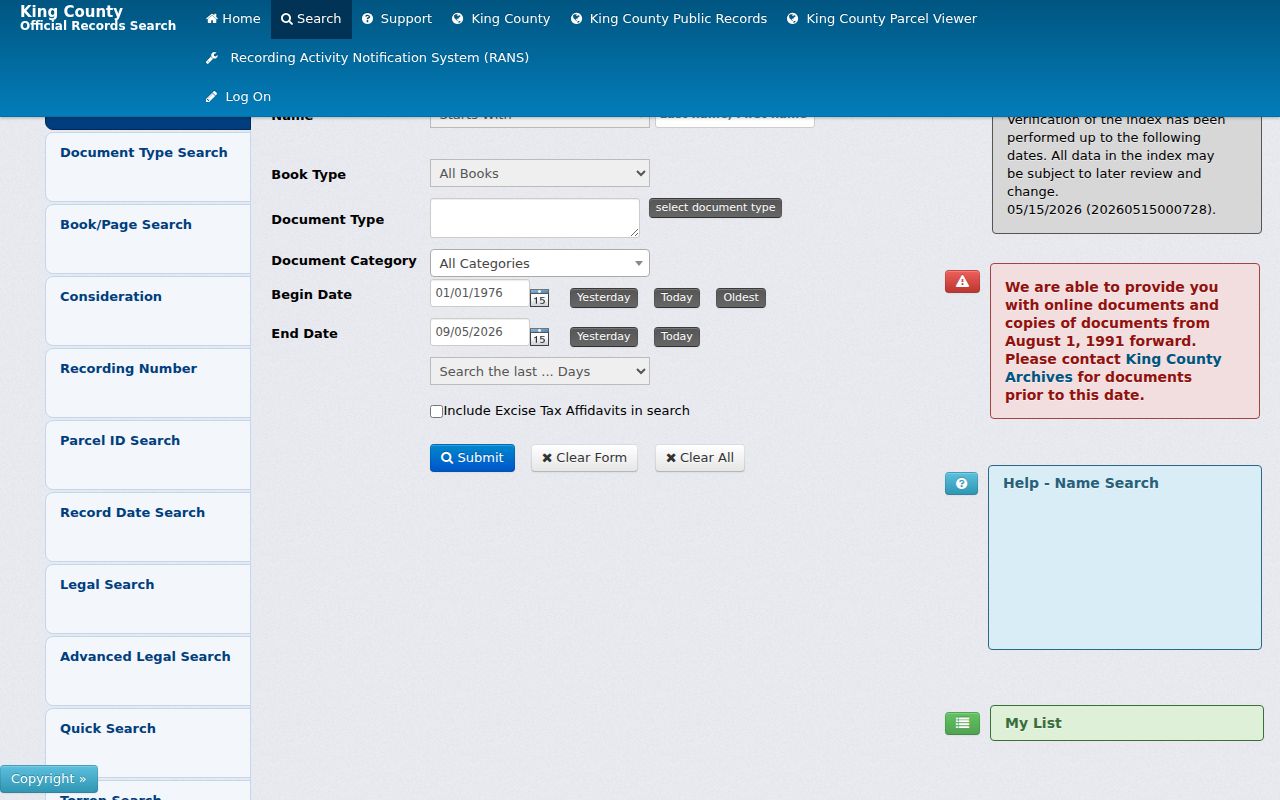
The tabbed interface is a reminder to preserve each recording number and search key before shifting from parcel to party or legal-description searches.
Copies are available online for many post-1991 documents. Other copies can be requested by mail or in person from the Recorder at 201 South Jackson Street, Suite 204, Seattle. The office lists weekday service from 8:30 a.m. to 4:30 p.m. and instructs mail customers not to send cash. For older work, King County Archives accepts phone and email consultation, offers limited Tuesday and Wednesday walk-in service, and requires an appointment for research-room use.
Kirkland Previous Resident Property Cards
The Washington State Archives Puget Sound Regional Branch holds a different kind of evidence. King County tax-assessment rolls extend from 1866 through 1937 with substantial gaps, especially before 1900. Real-property cards from 1937 through 1972 can contain a photograph, sketch, construction date, assessed value, parcel details, occasional ownership or excise notes, and some permit context.
These cards are useful for dating a Kirkland building, but they are not complete title abstracts. They may omit taxpayers, owners, purchase price, blueprints, architect or builder, easements, zoning changes, and the reason land was divided. They also cannot be retrieved reliably by street address alone. Send the branch a parcel or legal description, likely period, and exact research question before an appointment.
The Puget Sound Regional Branch is in Bellevue and offers weekday research by appointment. County Archives is a separate Seattle repository. Ask which institution holds the needed series before traveling. FamilySearch's Washington County Land Records collection, covering 1850 through 1954, may provide an online or browse-image lead, though account and image limits can apply.
Find Kirkland Past Households
Owners are only part of the story. Dated directories and census schedules can identify a published household connection to an address. Kirkland Heritage Society links an 1888 Polk scan, a 1910-11 local directory, a 1930 address list, and early phone-book runs. The State Archives and State Library list additional King County and Bellevue volumes that include Kirkland in various years.
Pair sources in a fixed sequence:
- Choose a directory year close to a deed transfer or property-card date. Copy the full entry, including initials, spouse, occupation, widow notation, phone, and locality code.
- Check a nearby public census year. Search name variants and the historic locality, then inspect the full household and enumeration context.
- Compare the street or legal location with the parcel, Sanborn sheet, and recorded instrument. Do not merge same-name people on the basis of a ZIP or surname.
- Repeat in the next available directory year. Mark gaps as gaps instead of assuming the same household remained.
The 1910-11 scan includes entries with spouse names, occupations, public roles, and a notation such as “h Seattle.” That home notation can show why a person appears in a Kirkland business or civic list without living at a Kirkland address. The full collection history belongs on the Kirkland city directory page; here, each volume serves as one dated step in the address chain.
Kirkland Past Resident Research Routes
Kirkland Heritage Society offers a strong local orientation because its resource pages point to directories, phone books, the East Side Journal chronology, archives, libraries, historic newspapers, Sanborn maps, and genealogy databases. Its own house-history account notes that older work once required physical tax-roll books and library research. That remains a useful warning: not all previous-resident evidence is searchable by address online.
The successful Kirkland Heritage local-resources capture shows the institutional links available for a house-history handoff.
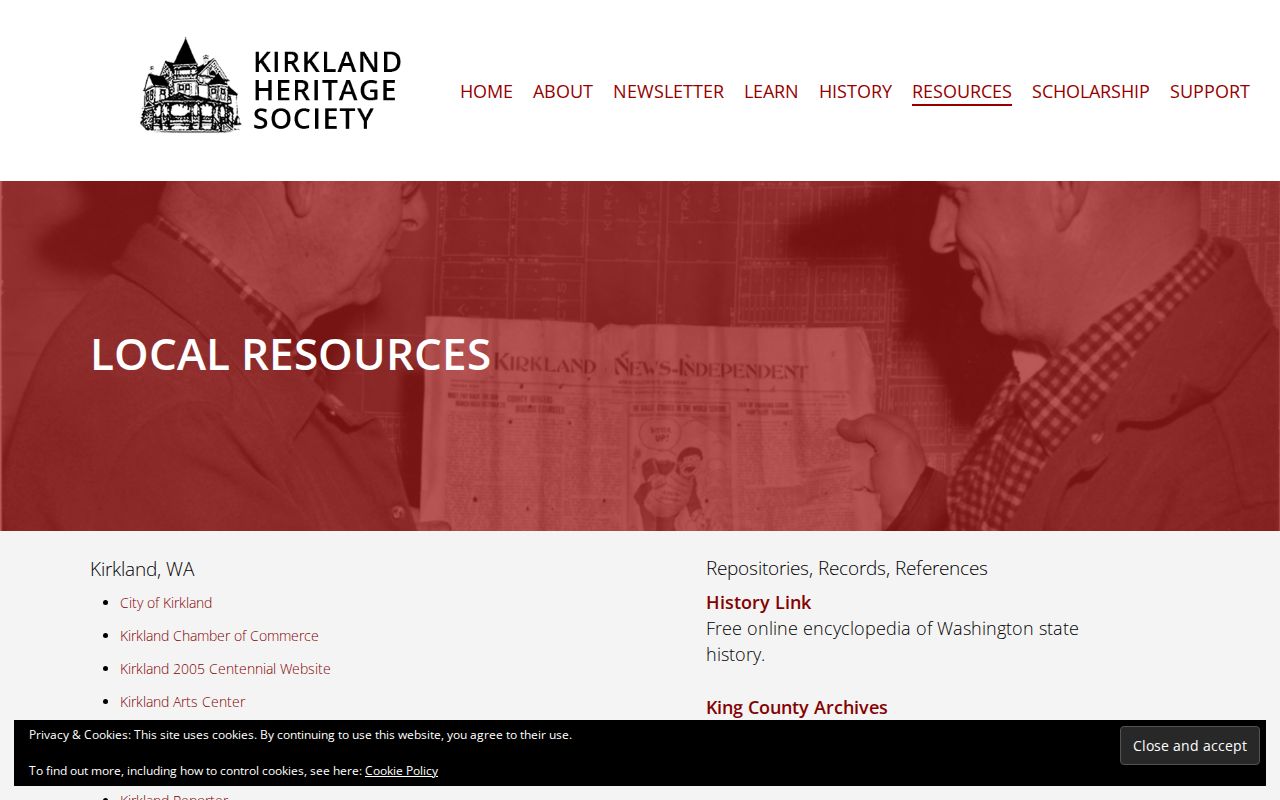
The resource list helps route a question to the right archive instead of treating one directory scan as a complete address history.
Kirkland Library provides a local starting point, but its public page does not promise a shelf-level Kirkland directory collection. Seattle Public Library genealogy staff can help in person, by phone, or virtually, with directories, newspapers, census sources, Sanborn maps, and obituary databases. The State Library closed general public access in 2025 and now describes limited Thursday appointments by email, so confirm its current access route.
Map Kirkland Past Resident Buildings
A Sanborn fire-insurance map can test whether a structure stood on a site and show use, footprint, materials, and hazards. The Library of Congress has a verified February 1892 Kirkland sheet. A City historic-context document contains an April 1926 Sanborn visual. These maps describe the built setting, not the names of previous residents.
Use the map with a property card, directory entry, deed, and census record. A building may have been replaced while the parcel stayed intact. A former business use can explain why a directory lists a proprietor at the site. Historic surveys also show that Market and Norkirk had older clusters while later-annexed Rose Hill, Juanita, and Finn Hill included farms, orchards, and rural lots with patchier address and permit records.
Kirkland's wartime growth adds context without identifying a household. The Lake Washington Shipyard expanded from about 250 workers in 1939 to more than 8,000, and a county public authority built more than 1,600 dwelling units in 1942 and 1943. A directory, census, or deed is still needed before connecting any person to a specific property.
Note: Cite a historical resident as “listed in” a named source and year, not as an unqualified statement of residence.
Close a Kirkland Resident Trail
Obituaries, newspapers, marriage records, probate files, and cemetery sources can explain where a previous-resident trail ends or branches. Seattle Public Library offers newspaper and obituary resources, while Kirkland Heritage Society points to local chronology and research links. The Washington Digital Archives King County marriage collection spans 1855 through 2017, but a historical marriage document is evidence of an event, not a current relationship.
Probate records are held through King County Superior Court, County Archives, and State Archives according to age and series. The Puget Sound branch describes probate indexes from 1853 through 1977 and causes from 1853 through 1971. Search the name and date, then ask for the actual file. An index alone may not establish an heir or the address involved.
For living people, stop when the official and published historical trail ends. Safe at Home protects qualifying participants through designated-address rules, and other records may be sealed, restricted, redacted, or absent from public views. A no-result can mean a protected address, wrong custodian, old locality, spelling issue, or coverage cutoff.
Lawful use. Research Kirkland previous residents for house history, genealogy, estate work, or personal curiosity. Never use a historical lead to track, threaten, or harass a living person.
Protect a Current Kirkland Title
House-history research can reveal an unexpected instrument. Current owners can use King County's free Recording Activity Notification Service, or RANS, to watch a personal name, business name, or parcel. Its parcel field uses the first ten digits without spaces, symbols, or dashes. An email alert signals matching recording activity; it does not block a recording or guarantee that fraud occurred.
The successful King County RANS capture shows the official enrollment route tied to recording activity.
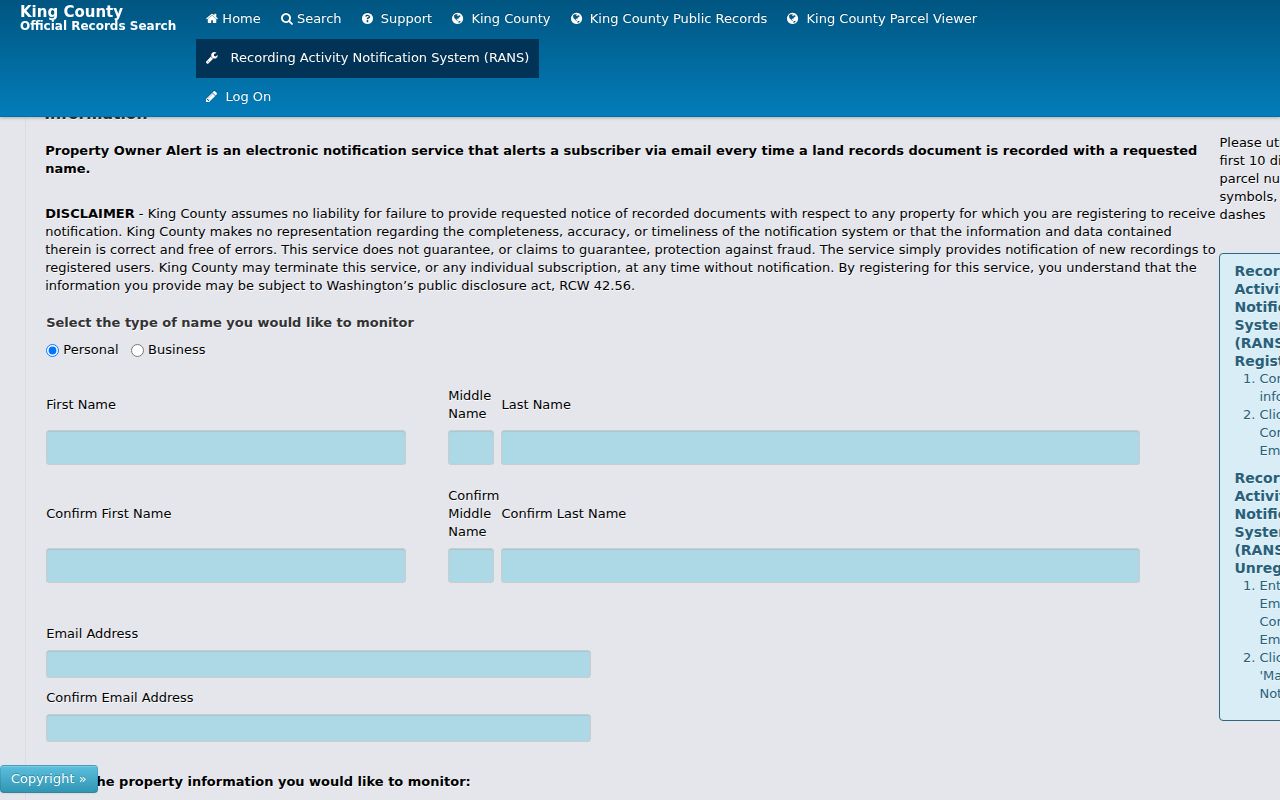
When an alert looks wrong, preserve its recording number, inspect the document, and contact the Recorder through its official page or phone number. RANS is a practical safeguard, not a replacement for the deed chain.